
发布时间: 12/30/2025
From December 15 to 18, the 18th ACM SIGGRAPH Asia conference and exhibition took place at the Hong Kong Convention and Exhibition Centre (HKCEC). This premier event in computer graphics and interactive techniques centered on the theme "Generative Renaissance," exploring how AI is transforming creative industries. It drew over 7,000 attendees worldwide and more than 600 speakers, with giants like Tencent, Huawei, and Adobe unveiling their latest AI-driven graphics breakthroughs.
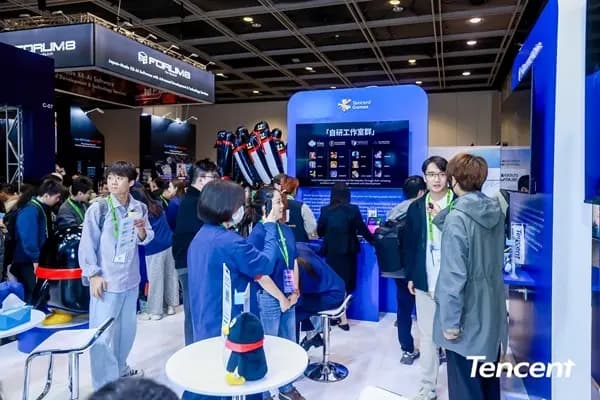
Tencent stole the show with workshops on "Neural Graphics and Generative AI," highlighting advances in 3D perception world models and the journey from research papers to billion-scale products. Tencent Games contributed nine accepted papers and three specialized talks, diving into AI's role in asset creation and engine rendering. Experts from around the globe joined in lively discussions, sparking ideas on Tencent Games showcases generative AI scene tools, animation pipelines and engine tech at SIGGRAPH Asia 2025.
AI Revolutionizing Game Production Pipelines and Elevating Content Quality
Tencent Games' paper "Imaginarium: Vision-guided High-Quality Scene Layout Generation" landed in the Technical Papers track. It tackles the headache of manually laying out vast non-core areas in open-world games, like urban streets or natural landscapes, with a vision-guided AI method for superior 3D scene layouts. Tencent expert Zhu Xiaoming explained how Imaginarium acts like a smart designer—it parses text prompts, matches art styles, and crafts logical layouts, freeing artists to focus on key creative elements.
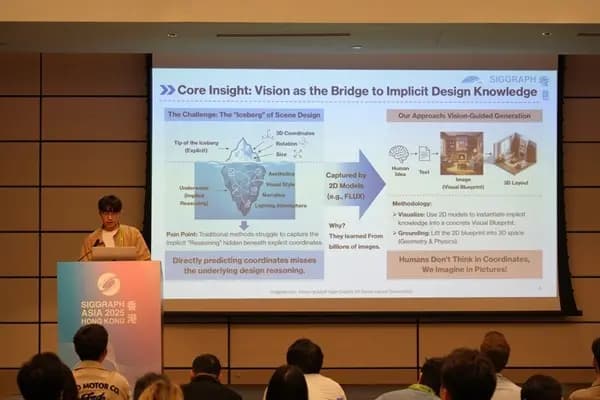
Zhu Xiaoming's talk on "Imaginarium: Vision-guided High-Quality Scene Layout Generation" emphasized its edge: not just mimicking placement, but reasoning like a human pro on why things go where they do, grasping scene logic and narrative flow through deliberate, slow thinking.

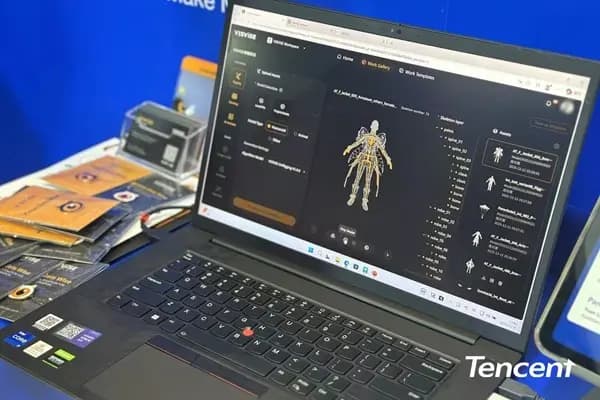
Picture prompting "a cozy living room with comfy armchairs, gallery wall, and stylish coffee table"—that's the kind of vivid result it spits out effortlessly. Building on their Gamescom demo, Tencent's VISVISE team launched the industry's first full AI 3D animation pipeline. VISVISE AI animation lead Zeng Zijiao presented "Breathing Life into Geometry: Full-Process AI Pipeline for 3D Character Animation," breaking down updates to skeletal generation, smart skinning, animation creation, and smart in-betweening.
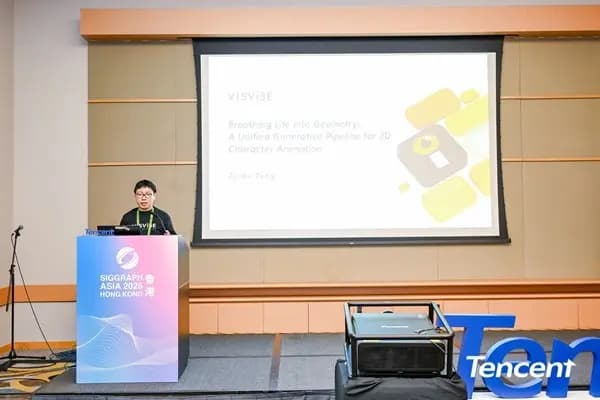
Zeng Zijiao's session on "Breathing Life into Geometry: Full-Process AI Pipeline for 3D Character Animation" showed seamless integration into game pipelines, boosting efficiency dramatically. Hands-on demos at their booth let visitors craft 3D character animations quickly. VISVISE powers nearly 100 projects like Peacekeeper Elite, Honor of Kings, PUBG Mobile, Teamfight Tactics, and League of Legends: Wild Rift, slashing production time by over 8x.

VISVISE workflow illustration
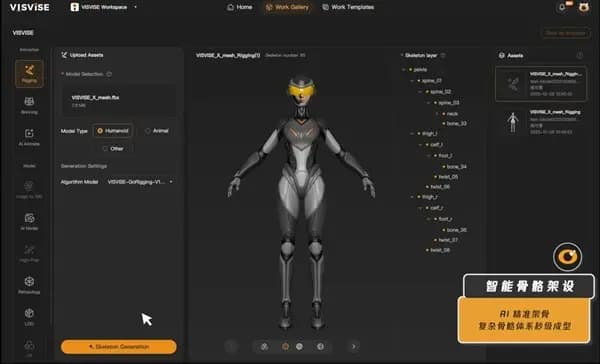
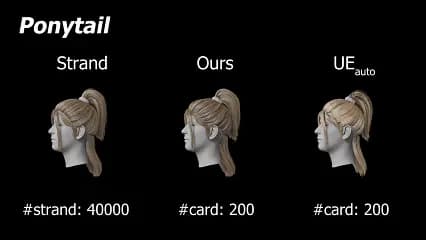
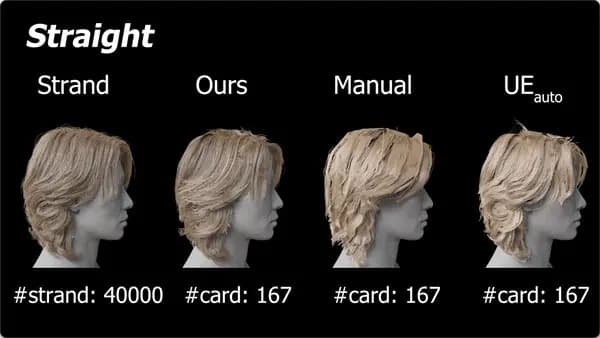
Smart skeletal rigging in action—generating now. Beyond pipelines and AI rendering, Photon Studio Group's Wu Kui and Zheng Zhongtian shared "Automatic Hair Strand Extraction via Differentiable Rendering" in Technical Papers, covering asset breakdown, preprocessing, and rendering to cut redundant art tasks while maintaining quality.
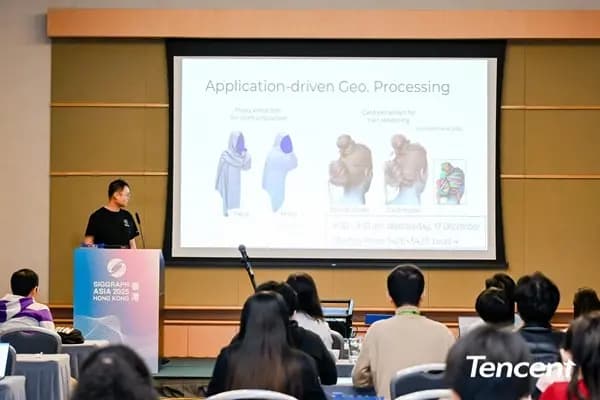
Wu Kui and Zheng Zhongtian's talk: "Automatic Hair Strand Extraction via Differentiable Rendering"
Traditional multi-view 3D modeling often struggles with geometry consistency and complex topologies in games. Tencent's Weikai Chen and team introduced SPGen, a spherical projection-based single-image 3D shape generator ("Spherical Projection as Consistent and Flexible Representation for Single Image 3D Shape Generation"). It projects surfaces onto a bounding sphere to sidestep view inconsistencies, nailing complex geometries with diffusion priors, better accuracy, generalization, and low GPU needs—just 96GB across two cards for training—empowering devs for smarter, faster modeling.
Tencent's Du Xingyi contributed to "Lifted Surfacing of Generalized Sweep Volumes," a fresh framework for complex swept volumes, auto-generating non-self-intersecting, closed 3D boundary surfaces via precise math. This boosts modeling precision for intricate geometries and topologies, ideal for virtual environments and props, streamlining game dev workflows.
AI + Game Engines: Enhancing Rendering, Crafting Immersive Audio-Visual Experiences
Tencent Games showcased AI innovations across lighting, animation, physics, geometry, and real-time rendering, paving the way for deeper immersion and smoother gameplay. Graphics evolution keeps pushing game visuals forward, with in-game AI rendering in the spotlight. Tencent's chief rendering researcher Li Chao unpacked MagicDawn—their cross-engine lighting solution—in his talk "Frontier Rendering Tech and Game Practice: Breaking AV Boundaries for Next-Gen Interactions."
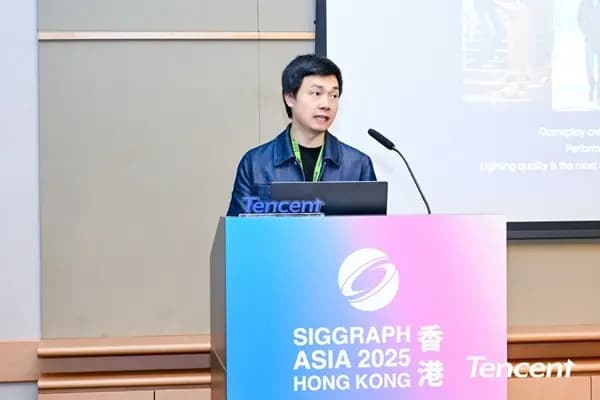
Li Chao's live demo: "Frontier Rendering Exploration and Game Practice—Breaking AV Limits, Building Next-Gen Experiences"
MagicDawn delivers dynamic day-night cycles, AI-optimized data compression, and efficiency gains, cutting bake times from days to hours—even enabling AAA-level shadows on mobiles. It solves global illumination bottlenecks with an end-to-end path from tech choice to deployment, proven in Escape from Tarkov: Dark Zone, Infinite Dark Zone, Wuthering Waves, and Lock Kingdom World.
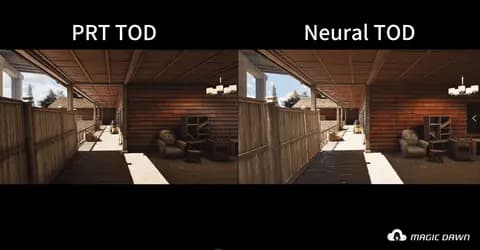

Intelligent rendering effects demo
For animation, Tencent Magic Square Studio Group's Xilei Wei, Lang Xu, Yeshuang Lin, and Zhejiang University collaborators presented "Ultrafast and Controllable Online Motion Retargeting for Game Scenarios." Their semantic-aware geometric rep solves retargeting actions to varied body types quickly (0.13ms per frame), controlling contacts and interactions for lifelike crowds.

In geometry, Photon experts Wu Kui et al. shared RL-ACD ("RL-AcD: Reinforcement Learning-Based Approximate Convex Decomposition") with Zhejiang University, offering compact reps for complex scenes and models—key for large-scale interactive worlds. Wu Kui also covered "Kinetic Free-Surface Flows and Foams with Sharp Interfaces," mastering efficient, stable fluid sims with rich foam details.
Facing high-fidelity high-fps challenges, Yuan Yazhen's team offered predictive sparse shading for frame extrapolation, rendering only complex areas under tight budgets for stable, detailed high-fps. For VR/AR, StereoFG ("StereoFG: Generating Stereo Frames from Centered Feature Stream") alternates low-res mono renders, using neural nets for synced high-quality stereo—quadrupling efficiency.
Closing Thoughts
ACM SIGGRAPH Chair and Peking University Prof. Chen Baoquan highlighted the event's focus: "3D graphics' pivotal role in AI and emerging industries." Games, blending 3D graphics, physics, and real-time interaction, stand as prime AI playgrounds.
Since 2016, Tencent Games has woven AI into training, pipelines, and titles like Honor of Kings and Peacekeeper Elite, adding AI assistants and war dogs for fresh play. This high-fidelity, interactive canvas accelerates AI deployment, turning frontier tech into tangible fun for millions—watch these SIGGRAPH Asia 2025 reveals shape tomorrow's player thrills.